
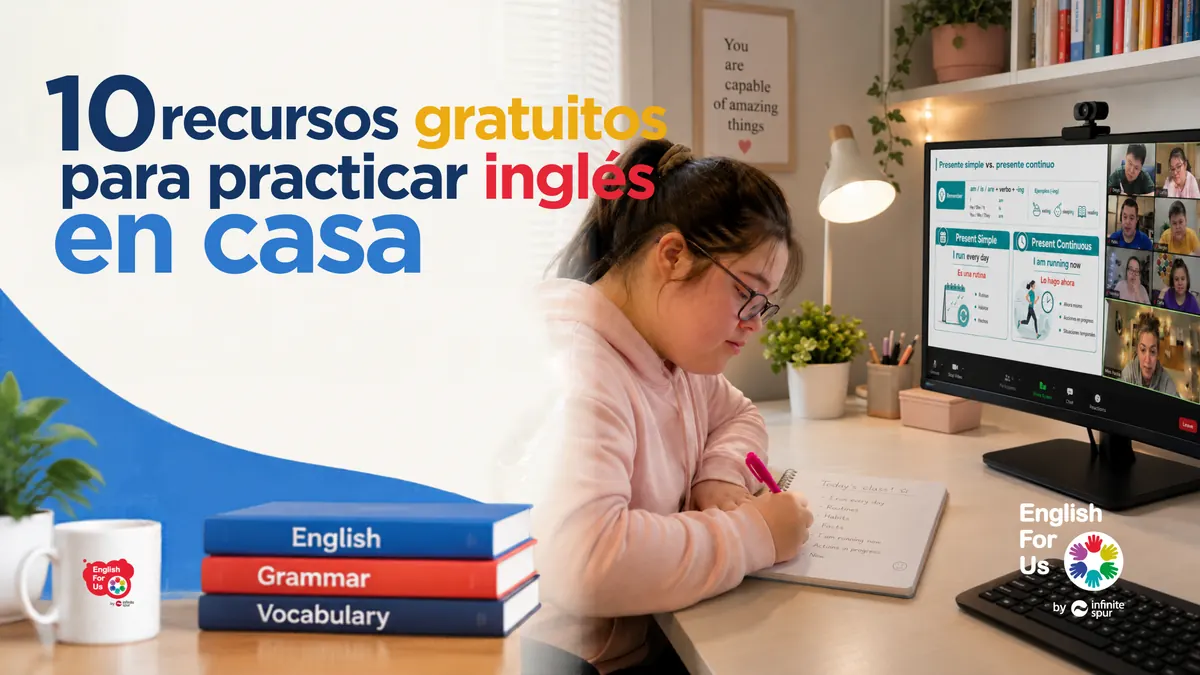
A little bit of English every day
Practising English doesn't mean doing more homework. The language can also be part of what we already do every day: listening to a song, watching a story, playing, reading, writing or simply trying to say something in a different way. We have gathered 10 free resources to keep practising English at home in a simple, fun way, adapted to different ways of learning.
To improve our English we don't always need to spend long hours studying.
Adding small moments of contact with the language to our routine can help us become familiar with new sounds, words and expressions in a much more natural way.
A song while we have breakfast. A short video. A game. Five minutes of reading. Writing a few sentences about our day.
What matters is finding activities we can keep up over time and, above all, that make sense for the person who is learning.
Because practising English at home can also be WATCH · LISTEN · READ · PLAY · SPEAK · CREATE.
Here are 10 resources to get started.
01 · British Council LearnEnglish
Ideal for: practising a little bit of everything.
LearnEnglish brings together free activities to work on listening, reading, writing, speaking, grammar and vocabulary, as well as videos, audio and stories organised by level.
It is especially useful when we want to practise in a more structured way and choose activities suited to our level.
TIP · Don't try to work on every skill at once. Choose a small goal: listening today, vocabulary tomorrow and reading another day.
02 · BBC Learning English
Ideal for: listening to English in different situations and topics.
Videos, audio and short content can help us get our ears used to English and discover vocabulary and expressions in context.
You can choose content that really interests you and listen to it first without worrying about understanding every word. Then listen again and try to recognise expressions you already know.
EFU TIP · Understanding English doesn't mean translating every sentence in your head. Context also helps us understand.
03 · YouTube
Ideal for: learning by watching.
Yes, YouTube can also become a tool for practising English.
Tutorials, cartoons, recipes, crafts, gameplays, science, music… The advantage is that we can use our own interests as a way into the language.
To start, we can choose short videos on topics we already know and use subtitles when needed.
The question doesn't have to be “Which video will help me study English?”, but also:
“What do I like watching, and how can I start watching it in English?”
04 · LyricsTraining
Ideal for: learning by listening to music.
Songs can be a fun way to work on listening comprehension, vocabulary and pronunciation.
LyricsTraining turns listening to songs and music videos into an interactive activity in which we have to recognise the words we hear.
And it has another important advantage: we can choose music we really like.
TIP · Choose a song you already know. When the context is familiar, it is much easier to start identifying new words and expressions.
05 · Storyberries
Ideal for: reading stories in English.
Reading doesn't have to start with a novel hundreds of pages long.
Tales and short stories let us practise for a few minutes, lean on the illustrations and understand the meaning of many words thanks to the context.
We can read a whole story or just a few pages. What matters is that the level is accessible and that reading doesn't turn into a race to look up every word in the dictionary.
06 · Project Gutenberg
Ideal for: readers who want to go a little further.
Project Gutenberg offers a large digital library of public-domain books that can be read for free.
It is an especially interesting option for more advanced students who want to start reading complete works in English.
There's no need to start with something complicated. We can look for short tales, stories or stories we already know.
TIP · Already knowing a story can help us a lot when we start reading it in another language.
07 · Wordwall
Ideal for: learning through play.
Matching words, sorting concepts, completing activities, answering questions…
Interactive games can help us practise vocabulary and language structures in a much more dynamic way.
And playing also lets us repeat an activity several times without the repetition necessarily feeling like doing the same exercise over and over again.
08 · Baamboozle
Ideal for: playing and practising together.
Learning English can also become a shared activity.
Baamboozle offers games and quizzes that can be used to practise vocabulary and different content in a playful way.
It can be especially fun when we practise with brothers and sisters, friends or family.
Because using English to play is also using the language with a purpose.
09 · Cambridge Dictionary
Ideal for: discovering how words are really used.
A dictionary can do much more than give us a translation.
Cambridge Dictionary lets us look up meanings, examples and pronunciations, which is especially useful when we come across a new word while watching a video, listening to a song or reading.
Instead of learning an isolated word, we can see how it appears within a sentence.
TIP · When you discover a new word, try to make up your own example with it. It will be much easier to remember.
10 · Your own voice
Ideal for: practising speaking without needing anyone else.
This last resource is already at home and is completely free.
Talking to ourselves in English may feel strange at first, but it is a simple way to start actively using what we are learning.
We can describe what we are doing: I’m making breakfast.
Talk about something that happened to us: Today I went to…
Explain what we see around us, make up a story or record ourselves for a few seconds and listen back.
We don't need to build perfect sentences.
We need to start using the language.
Not everything works the same for everyone
Maybe you enjoy watching videos but find it hard to stay focused when reading.
Maybe you quickly remember the lyrics of a song, while someone else prefers learning through play.
You may need to rely on images, listen to the same audio several times or practise for shorter periods.
And that's fine.
There isn't one single right way to practise English.
The best resource is the one that works for you
At English For Us we believe that learning also means discovering how we learn best.
That's why you don't need to use all ten resources on this list.
Try. Explore. Keep the ones that spark your curiosity, suit your level and fit naturally into your day-to-day life.
Five or ten minutes can be enough to start.
A song. A story. A game. A video. A sentence.
Because when English becomes part of what we do, practising stops feeling like just studying.
WATCH · LISTEN · READ · PLAY · SPEAK · CREATE. Find your way of learning.